

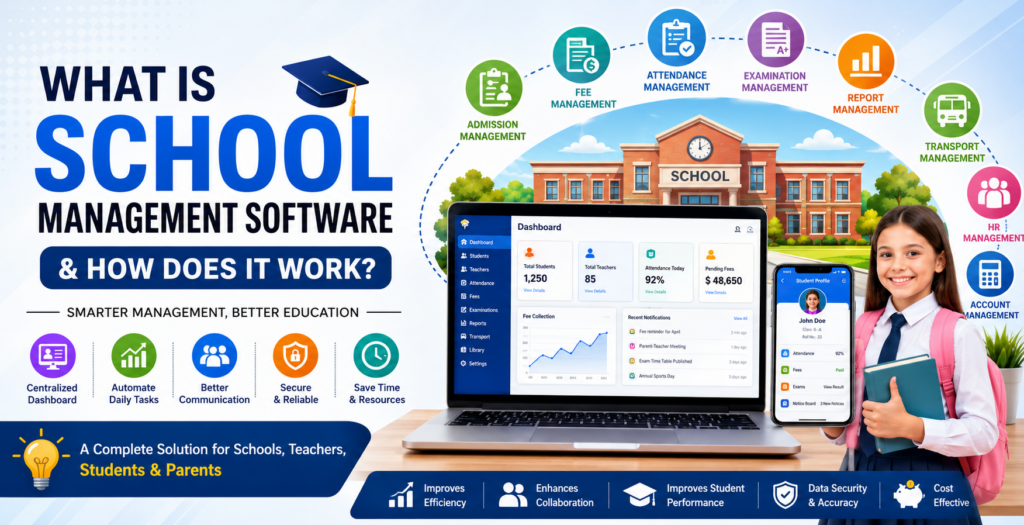
School management is not all about teaching the pupils. Educational institutions have many administrative issues, starting from admissions, fees, attendance, examination, and other activities that happen on a daily basis. Manually handling such activities is likely to be inefficient since many errors can easily occur. Therefore, the use of school management software is very important in such scenarios.
The School Management System (SMS) is an online system that automates various academic activities taking place in schools and colleges. The SMS also simplifies various administrative
Today’s schools must have an efficient process of managing operations. School management software makes life easier for schools since it automates mundane processes that take time and effort.
Important Modules of School Management Software
1. Admission Management
The admission management module streamlines the process of admitting
students to schools. It allows users to manage student inquiries, perform
admission tests, verify documents, and facilitate admission processes from one
central point.
Features of the Module:
·
Online form submission
·
Inquiry management for students
·
Scheduling admission tests
·
Documents verification
·
Admission records
·
Transfer certificate management
This module makes admission procedures less cumbersome and
faster.
2. Fee Management
The administration of fee management plays an important role in any
educational institution, and the Fee Management Module simplifies all the fee
related tasks such as calculation of fee, payment, and receipt.
Features:
·
Payment of fee online
·
SMS and email reminders regarding fee payment
·
Calculation of fines automatically
·
Management of discount and scholarships
·
Tracing of outstanding fees
·
Payment history
This will ensure smooth payment of fees on time.
3. Management of Attendance
Tracking of attendance becomes easy and reliable by using digital
attendance systems. The school can check attendance on a daily basis for
students, teachers, and staff members.
Features:
·
Daily attendance
·
Leave management
·
Monthly/annual attendance report
·
Analysis of attendance and attendance chart
·
Biometrics compatibility
The system aids institutions in understanding attendance
trends and enhancing their accountability.
4. Student Information Management
It acts as the central source for all information related to the students.
Features:
·
Student’s personal information
·
Academic records
·
Information of parents/guardians
·
Medical records
·
Student ID card creation
·
Sibling information management
The administrators can view and edit the data related to the
students anytime and anywhere.
5. Timetable Management
The process of manual creation of class timetables is often tedious.
Through the Timetable Management Module, schools are able to effectively create
and manage timetables.
Main Features:
·
Timetable generation
·
Classroom allocations
·
Subject allocations
·
Examination timetabling
·
Conflicts resolution
Teachers and pupils are always able to access their
timetables online.
6. School Administration Management
This particular module is designed for helping manage school operations via
a single interface.
Main Features:
·
Academic management
·
Administration processes
·
Resource management
·
Communication management
·
School notifications
It ensures proper coordination between departments.
7. Transport Management
For schools using transport services such as buses and vans, the Transport
Management module comes in handy.
Features:
·
Vehicle tracking
·
Routing
·
Driver management
·
Vehicle maintenance
·
Student route allocation
·
Fee management for transportation
The real-time tracking feature offers security for the
children and peace of mind for parents.
8. Report Management
There is a need for reporting by educational institutions. This module
helps create and manage reports efficiently.
Features:
·
Academic reporting
·
Attendance reporting
·
Financial reporting
·
Performance analysis
·
Report customization
Administrators can quickly access accurate data for
decision-making.
9. Examination Management
Conducting examinations by manual means can prove difficult. The
Examination Management Module makes exam management and evaluation process
easier to handle.
Main Features:
·
Examination scheduling
·
Recording marks
·
Evaluation results
·
Generation of report cards
·
Analysis of results
·
Results posting
10. Account Management
Transparency of financial records is important to any educational
institution. The Account Management Module facilitates easy handling of
financial affairs.
Main Features:
·
Recording income and expenditures
·
Management of salaries
·
Maintenance of ledger
·
Financial reports
·
Budget preparation
·
Auditing of accounts
11. Billing and Invoicing
Billing module handles billing and invoicing processes.
Features include:
·
Auto-generation of invoices
·
Digital payments
·
Reminders for payments
·
Generating receipts
·
Financial reports
This ensures that there is prompt payment of fees.
12. HR Management
Schools should be able to coordinate teachers and other workers
efficiently. HR module simplifies the process of handling employees.
Features include:
·
Handling of employee records
·
Processing of payroll
·
Managing leaves
·
Performance appraisal
·
Support in recruitment
·
Salary reports
This makes HR management easier.
13. Parent Engagement System
The participation of parents in the education process is critical to their
children’s success. The modern school management system offers parent portals
and applications for their smartphones.
Features:
·
Tracking of student performance
·
Information on attendance of students
·
Details of fee payment status
·
Monitoring of homework assignments
·
Direct contact with teachers
Emerging Technologies in School Management Software
Modern School Management Systems are incorporating new technologies like:
· Artificial Intelligence (AI)
· Data Analytics
· Mobile Applications
· Cloud Computing
· Gamification
· Virtual Learning Solutions
· Online Assessments
Such technologies improve learning outcomes and help increase efficiencies.
Advantages of School Management Software in Cloud Computing
There are many benefits that cloud computing offers over conventional software:
· Safe data storage
· Remote access
· Automatic backups
· Cost savings on hardware and support
· Increased security for sensitive data
· Scalability
Schools do not have to invest in costly physical servers and still keep their data safe and available.
Conclusion
The advent of school management software has revolutionized the functioning of educational institutions. With features like automation of admissions, attendance, payment of fees, examination, accounts, and communication, schools can be more efficient in their operations and can pay attention to imparting good education.
In today’s era of digitalization, where most of the institutions are adopting technology in order to streamline operations and achieve growth, the use of school management system has become inevitable.
Sign up for our newsletter to receive valuable insights, updates, and exclusive event information delivered straight to your inbox.