

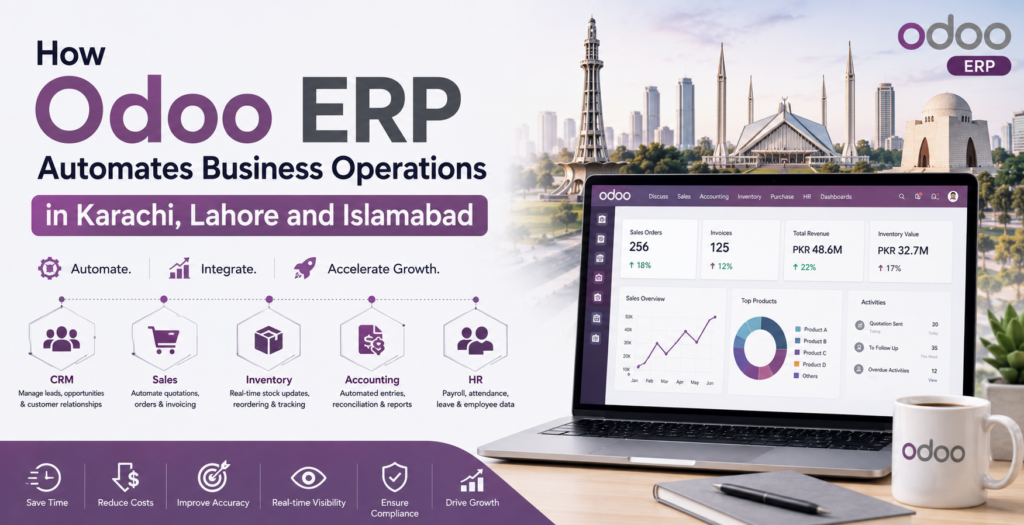
With the increased adoption of digitalization in organizations, automation is one of the important factors for improving efficiency and growth of businesses. Organizations are implementing automation through the use of smart enterprise tools for increasing productivity, reducing costs, and decision-making. "How Odoo ERP Automates Business Operations in Karachi, Lahore and Islamabad" is one of the topics which has gained much attention among business leaders.
Enterprise Resource Planning (ERP) is a comprehensive business management system where all core activities of an organization, including financial activities, sales, inventory, procurement, manufacturing, human resource management, customer relationship management (CRM), and reporting are integrated together in one single system. Odoo ERP is a cost-effective solution for business operations of enterprises operating in Pakistan and the Middle East.
It is not uncommon to find many firms using independent software applications, spreadsheet programs, and manual processes in order to run their operations. Such methods are likely to bring about duplication of effort, delays in approving activities, inconsistent reports, and miscommunication across the departments within the organization.
Another challenge faced by enterprises relates to data silos. It is common for different departments within an organization, including finance, procurement, human resources, sales, and warehouses to have their own databases. This makes it hard to obtain up-to-date information from any department.
There is also an increase in regulatory and compliance needs that businesses need to adhere to. Manual reporting takes time and poses a high risk of error.
Importance of Automation in ERP
Automation in business helps organizations standardize processes, reduce redundancy, and facilitate cooperation within different departments. Odoo ERP allows for business processes unification in one system that ensures the information exchange throughout the whole company.
Through the automation, employees will be able to increase their productivity in terms of purchase order approval, quotation, invoice creation, payroll calculation, goods replenishment, and communication with customers. Thus, employees will spend more time on activities aimed at business development rather than administrative tasks.
The most important aspect of Odoo ERP is its integration. Such modules as CRM, Accounting, Inventory, Manufacturing, HR, Project Management, Sales, Purchase, Marketing, and Business Intelligence are integrated into one ecosystem and allow top managers to monitor the dashboard in real time and make right decisions based on performance indicators.
It should be noted that technology is not enough; implementation and training, as well as experienced ERP consultants, are needed.
Odoo ERP Software for Automation of Business Activities
Odoo ERP software enables the automation of numerous processes by means of intelligent workflows and data centralization.
Sales teams can easily convert leads into quotations, sales orders, invoices, and customers without entering the same data more than once. Modules for inventory management will update the number of items in the inventory after each purchase or sale, thus preventing problems with inventory shortages.
Automated accounting, banking transactions, expense management, and financial reporting are provided to the finance department, whereas human resources can implement automated processes related to recruitment, attendance, payroll processing, leave management, and performance monitoring.
Purchase recommendations are provided to procurement specialists depending on inventory levels, and approval processes are performed in accordance with organizational policies.
Decision-makers can always be aware of current activities thanks to cloud and mobile access possibilities.
Key Benefits
Implementation Perspective
ERP automation should be implemented by the organizations via a phased process rather than trying to change everything all at once.
The implementation process starts with business process analysis, requirement gathering, workflow mapping, and goal setting. Good master data, executive involvement, and employee participation are key success factors for successful implementation.
Collaborating with Odoo implementation experts will help to ensure proper system configuration, customization of the modules, data migration, and integration with other business applications.
The phased implementation process enables organizations to reduce risk while continually improving their processes to meet real-life business needs.
Conclusion
In light of the knowledge gained about How Odoo ERP Automates Business Processes in Karachi, Lahore, and Islamabad, organizations can identify the strategic significance of enterprise automation. With Odoo ERP, businesses are able to connect their departments, automate processes, enhance visibility, and make better decisions using a digital platform.
Organizations from all around Pakistan and the Middle East can find Odoo ERP useful in achieving operational excellence and digital transformation. If properly planned, implemented, and optimized, businesses will be more efficient and successful in the competitive business environment.
Sign up for our newsletter to receive valuable insights, updates, and exclusive event information delivered straight to your inbox.